We make FitFoodie, so weigh our view accordingly. Both apps log meals from a photo, a typed description or a barcode, and both put photo analysis behind a subscription. Cal AI does more on Apple devices (Apple Watch, Mac) and offers a 3-day trial. FitFoodie keeps barcode scanning, water and weight tracking free, shows fiber, sugar, sodium and saturated fat, and lets you edit every number before saving.
What is Cal AI, and who owns it now?
Cal AI is a photo-first calorie tracker. You point your phone at a meal and it estimates the calories and macros. On iOS it's published by Viral Development LLC. It has 4.8 stars from about 373,000 ratings on the US App Store (as of October 2026).
The bigger news is ownership. MyFitnessPal announced it had acquired Cal AI on March 2, 2026. TechCrunch reported that the deal closed in December 2025 and that the terms weren't disclosed. Citing MyFitnessPal, it also reported Cal AI had more than $30 million in annual revenue and more than 15 million downloads. Cal AI kept its seven-person team, including co-founder and CEO Zach Yadegari, and stays a separate app. MyFitnessPal itself is owned by Francisco Partners (Fitt Insider).
For you, the app works the same as before. Ownership matters in one case: if you're leaving MyFitnessPal and want a tracker from a different company, Cal AI is now part of the same one. Our MyFitnessPal alternative page covers that side.
You may also have read that Cal AI disappeared from the App Store. Apple briefly pulled it in April 2026 over billing and in-app-purchase guideline issues, and it was reinstated within days. It's live on both the App Store and Google Play.
How do FitFoodie and Cal AI compare feature by feature?
We only include rows we could confirm from Cal AI's own site and store listings, plus the press coverage linked below. If a feature isn't in the table, we couldn't verify it either way.
| Feature | Cal AI | FitFoodie |
|---|---|---|
| Photo logging | Yes, core feature. Uses the phone's depth sensor to estimate portion volume (calai.app) | Yes, one photo per meal. Premium |
| Describe a meal in text | Yes | Yes, up to 500 characters. Premium |
| Barcode scanning | Yes | Yes, free. Checks Open Food Facts, USDA FoodData Central and FatSecret in turn |
| Without a subscription | Free download; the App Store listing says "food scanning analysis results require a subscription" | Barcode, water, weight, history, edit/undo, re-add a past meal, reminders, weekly view, Settings export |
| Free trial | 3 days | 7 days on the yearly plan (new subscribers) |
| Price (US) | App Store lists in-app prices from $2.99 to $29.99 without billing periods; the paywall is tested in variations | See the App Store or Google Play listing |
| Platforms | iPhone (iOS 18+), Apple Watch, Vision Pro, Mac (Apple silicon), Android. No iPad or web app | iPhone (iOS 15+) and Android. No watch, web or desktop app |
| Published accuracy claim | Its FAQ says "about 80% accurate" | None published |
| Independent test | Included in a preliminary 2026 NIH study (see below) | Not independently tested |
| Owner | MyFitnessPal (deal closed Dec 2025, announced March 2026) | The FitFoodie team |
Last checked: October 2026. Sources: calai.app, Cal AI on the App Store, Cal AI on Google Play. Store prices change and Cal AI tests different paywalls, so check the listing before you subscribe.
What does Cal AI do better?
- More Apple devices. Cal AI runs on Apple Watch, Vision Pro and Apple silicon Macs as well as iPhone. FitFoodie is phone-only.
- Depth-based portions. Cal AI says it uses your phone's depth sensor to estimate portion volume. FitFoodie works from a single flat photo and asks you to confirm the portion.
- A short free trial. Cal AI offers a 3-day free trial, so you can test photo scanning before paying. FitFoodie's 7-day trial is longer but only comes with the yearly plan.
- A published accuracy number. You may not trust a self-reported figure (we explain why below), but Cal AI at least states one. We don't, because FitFoodie hasn't been independently tested.
Where is FitFoodie different?
FitFoodie is built around reviewing the AI's estimate before it lands in your log. Here's what that looks like in practice.
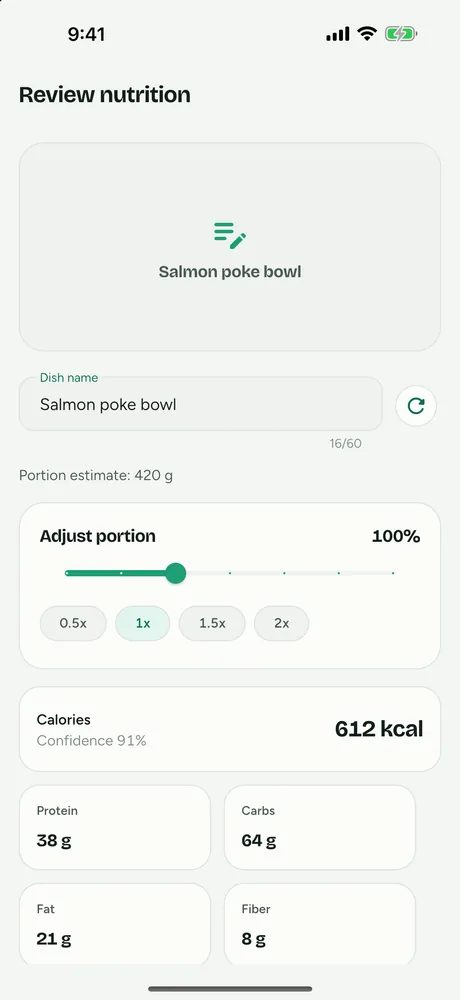
- Edit before you save. The AI gives one estimate for the whole dish. You can scale the portion from 0.5× to 2×, tap any of the eight nutrient values to change it, rename the dish, edit the ingredient list, and tag it as breakfast, lunch, dinner, a snack or a treat.
- Free barcode scanning. Scanning checks Open Food Facts, USDA FoodData Central and FatSecret in turn. If your meal photo shows a product barcode, FitFoodie uses the label data instead of guessing. More on the free barcode scanner page.
- More than macros. Each entry tracks calories, protein, carbs and fat, plus fiber, sugar, sodium and saturated fat.
- Free tracking around the AI. One-tap water logging, weight tracking with a 7-day trend and goal line, and a weekly view with days on target and streaks are all free. So is exporting your entries as CSV from Settings.
- Older phones and more languages. FitFoodie runs on iOS 15 and later (Cal AI needs iOS 18). It's available in English, Spanish, German, French and Arabic, and AI results come back in your language.
If you want the bigger picture of how photo trackers work before choosing, our AI photo calorie tracking guide covers recognition, portions and where estimates go wrong.
How accurate is Cal AI, and how accurate is FitFoodie?
Cal AI's own FAQ says it is "about 80% accurate." That's a company claim, and it doesn't say what was measured or how.
The best outside evidence is preliminary. At NUTRITION 2026 in July, NIH researchers presented an exploratory test of four photo-based apps: MyFitnessPal, Lose It!, Cal AI and Appediet. They used 102 standardized meal photos with weighed ingredients. On average, all four underestimated meals by roughly 250–345 calories and fat by about 30 g. The researchers didn't release per-app numbers, and the findings haven't been peer-reviewed yet. Our guide to how accurate photo calorie apps are goes through the study in detail.
FitFoodie wasn't in that test, and we don't publish an accuracy figure. It uses Google Gemini, and we found no peer-reviewed weighed-meal test of the Gemini model it runs. Treat every FitFoodie number as an estimate, and use the review step to fix it:
- Check the portion first. It's the biggest lever, and the slider runs from 0.5× to 2×.
- Raise fat and calories if the dish was cooked in oil or came with sauce the photo can't show. The NIH researchers said the apps underestimate calories “especially from fats.”
- For packaged food, scan the barcode instead. Label data beats a visual guess.
What doesn't FitFoodie do?
A fair comparison should say what you'd give up. FitFoodie does not have:
- Per-item nutrition. A plate with three foods gets one combined estimate, not three.
- Apple Health, Google Fit or Health Connect sync, or any watch app.
- Saved or favorite meals and recipes. The shortcut is one-tap re-add of a past meal.
- Food-database search by name, manual entry from scratch, or typing a barcode number.
- More than one photo per meal.
- Editable calorie and macro goals. Targets are calculated from your profile and update when you log a new weigh-in.
- Unlimited AI. Premium is capped at 10 analyses a minute and 150 a day.
Who should pick Cal AI, and who should pick FitFoodie?
Cal AI is likely the better fit if you:
- Want to log from an Apple Watch or Mac as well as your phone.
- Want to try photo scanning for a few days before paying.
- Have a recent iPhone (iOS 18+) and like the idea of depth-based portion estimates.
- Don't mind that it's now owned by MyFitnessPal.
FitFoodie is likely the better fit if you:
- Scan a lot of packaged food and want barcode scanning free.
- Want to see fiber, sugar, sodium and saturated fat, not just macros.
- Prefer to check and adjust each estimate before it's saved.
- Want free weight and water tracking in the same app.
- Use an older iPhone, or want the app in Spanish, German, French or Arabic.
Still comparing? See our SnapCalorie alternative page for a depth-sensing rival, or the Lose It! vs Cal AI three-way comparison.
Frequently asked questions
Is Cal AI owned by MyFitnessPal?
Yes. MyFitnessPal announced the acquisition on March 2, 2026, and TechCrunch reported the deal closed in December 2025. Terms were not disclosed. Cal AI continues as a separate app.
Is Cal AI still on the App Store?
Yes. Apple briefly removed it in April 2026 over billing and in-app-purchase guideline issues, and it was reinstated within days. As of October 2026 it is live on the App Store and Google Play.
Is FitFoodie free?
FitFoodie is free to download, and barcode scanning, water tracking, weight tracking, history and the weekly view are free. AI photo and text analysis are part of Premium, and the yearly plan starts with a 7-day free trial for new subscribers.
Does FitFoodie give calories for each item on the plate?
No. FitFoodie's AI returns one estimate for the whole dish, plus a list of ingredient names. You can scale the portion from 0.5x to 2x and edit any of the eight nutrient values before you save.