We make FitFoodie, so weigh our view accordingly. SnapCalorie is the stronger pick if you have an iPhone Pro and want LiDAR depth for portions, or want to log by voice. FitFoodie is the better fit if you want a free barcode scanner, fiber, sugar, sodium and saturated fat on every entry, and a review step where you edit every number. FitFoodie's photo and text analysis are Premium.
What is SnapCalorie, and who makes it?
SnapCalorie is a photo-based calorie tracker for iOS and Android from Perception Labs, Inc. It was founded by Wade Norris, a co-founder of Google Lens, and Scott Baron, an aerospace systems engineer. The company raised a $2 million seed round in 2023 from Accel, Index Ventures, Y Combinator and Eric Roza, as TechCrunch reported.
Its main feature is photo logging with depth. On iPhone Pro models, SnapCalorie uses the LiDAR sensor to judge how much food is on the plate, not just what it is. It also takes voice notes, and the developer says you can log by text.
Its research background is real. Norris co-authored Nutrition5k, a peer-reviewed Google Research paper (CVPR 2021) on estimating nutrition from food images. That paper is the basis for SnapCalorie's approach. It is not an independent test of the app, which matters when you read its accuracy claims below.
Is SnapCalorie free, and does it scan barcodes?
Its own sources disagree on price. SnapCalorie's website says "Core features are completely free" and calls the plan "Free Forever." Its US App Store listing shows Premium in-app purchases from $9.99 to $149.00, for example $19.99 monthly and $149.00 annual (as of October 2026). The fair reading is a free core tier plus a Premium subscription. Check the listing for what's included before you pay.
Barcode scanning is also unclear. It isn't in SnapCalorie's official feature list. The App Store listing mentions a "Nutrition Label Scanner," which isn't the same thing as a barcode scanner. Some user reviews mention barcodes, but we couldn't confirm it, so we treat it as unknown.
FitFoodie is clearer on both points, though not cheaper on AI. Barcode scanning is free and checks Open Food Facts, USDA FoodData Central and FatSecret in turn. AI photo and text analysis are part of Premium, with a 7-day free trial on the yearly plan for new subscribers.
How do SnapCalorie, Cal AI and FitFoodie compare?
People searching "Cal AI vs SnapCalorie" usually want both in one view, so we've added Cal AI. We list only what we could confirm from each company's site or store listing.
| Feature | SnapCalorie | Cal AI | FitFoodie |
|---|---|---|---|
| Photo logging | Yes; LiDAR depth on iPhone Pro | Yes; uses the phone's depth sensor | Yes; one photo per meal, Premium |
| Voice logging | Yes (voice notes) | Not confirmed | No |
| Text logging | Yes (per the developer) | Yes | Yes, Premium |
| Barcode scanning | Not confirmed; lists a nutrition label scanner | Yes | Yes, free (Open Food Facts, USDA, FatSecret) |
| Free tier | Website says core features free; App Store lists Premium from $9.99 to $149.00 | Free download; scan results need a subscription. 3-day trial | Barcode, water, weight, history, reminders, weekly view free. 7-day trial on the yearly plan |
| Platforms | iOS and Android | iPhone, Apple Watch, Vision Pro, Mac, Android | iPhone (iOS 15+) and Android |
| Accuracy claim | "The most accurate calorie tracker, period" (App Store) | "About 80% accurate" (FAQ) | None published |
Last checked: October 2026. Sources: snapcalorie.com, SnapCalorie on the App Store, calai.app, Cal AI on the App Store. For a closer look at Cal AI, see our Cal AI alternative page.
What does SnapCalorie do better than FitFoodie?
- Depth for portions. On an iPhone Pro, LiDAR gives SnapCalorie a direct measure of food volume. FitFoodie works from a flat photo and asks you to confirm the portion. Portion size is a major source of error in photo estimates, so this is a real difference.
- Voice logging. You can talk to SnapCalorie. FitFoodie has three ways to log: photo, typed description and barcode.
- A free core tier that may include AI. If the website's "Free Forever" plan covers the photo features you need, that beats FitFoodie, where all AI analysis is Premium.
- Published research behind the model. Nutrition5k is peer-reviewed work by one of its founders. FitFoodie uses Google Gemini, and we found no peer-reviewed weighed-meal test of the Gemini model it runs.
How accurate is SnapCalorie, really?
SnapCalorie makes strong claims. Its App Store listing calls it "THE MOST ACCURATE CALORIE TRACKER, PERIOD" and says it's about twice as accurate as estimating by eye. For a 500-calorie dish it cites an error of about ±80 calories on iPhone Pro and ±130 on other iPhones, against ±265 when people guess visually. Its website says it's "2x more accurate than nutritionists."
These are the company's own figures. The research they rest on, Nutrition5k, is a peer-reviewed computer-vision paper, not an independent check of the app you download. SnapCalorie also wasn't one of the four apps in the preliminary NIH test presented in July 2026, which found the apps it did test underestimated meals by about 250–345 calories on average.
No app has earned blind trust, ours included. FitFoodie publishes no accuracy figure. If you're comparing claims across apps, our guide to how calorie tracker accuracy is measured explains what to look for: weighed meals, independent testers and per-app results.
Does depth sensing matter if you don't have an iPhone Pro?
Less than the headline suggests. By SnapCalorie's own figures, the error on a 500-calorie dish is about ±80 calories with an iPhone Pro's LiDAR and about ±130 calories on other iPhones. So most of its advantage over guessing comes from the model itself, and the depth sensor adds a further step on Pro models.
Without depth, every photo app, FitFoodie included, has to infer portion size from a flat image. That's why FitFoodie puts the portion control first on its review screen: you can set it from 0.5× to 2× before you look at any of the numbers. If you know the portion was a cup of rice rather than two, fixing that one setting corrects calories, macros and the rest together.
Where is FitFoodie different?
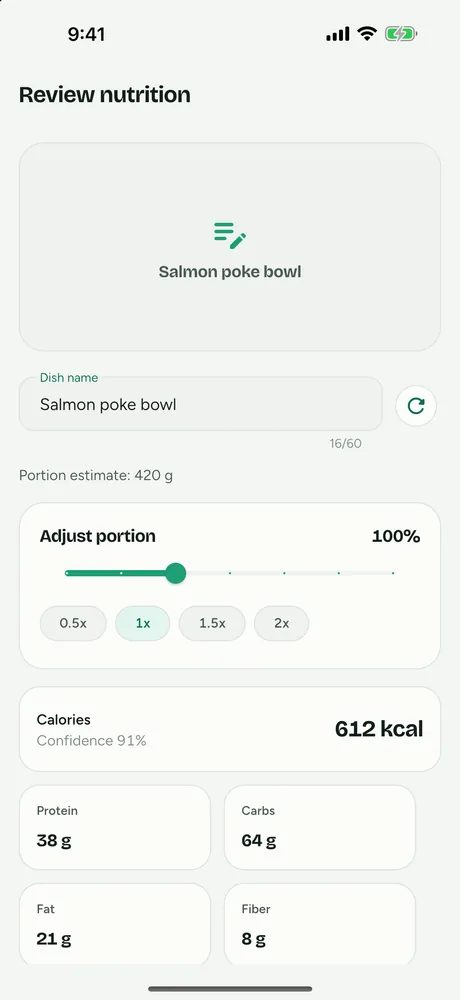
- You correct the estimate before it's saved. The AI returns one estimate for the whole dish. You can scale the portion from 0.5× to 2×, edit all eight nutrient values, rename the dish, edit ingredients and add a meal tag.
- Labels beat guesses. Barcode scanning is free. If a meal photo shows a product barcode, FitFoodie uses the label data instead of estimating.
- Four extra nutrients. Every entry has fiber, sugar, sodium and saturated fat alongside calories and macros.
- Free everyday tracking. Water, weight (with a 7-day trend and goal line), history with undo, one-tap re-add, reminders and a weekly days-on-target view are free.
- Five languages. English, Spanish, German, French and Arabic, with AI results in your language.
And what FitFoodie lacks: there's no voice logging, no per-item breakdown, no Apple Health or Health Connect sync, no saved meals or recipes, no food search by name, and AI use is capped at 150 analyses a day. For background on how all of these apps estimate food, read our food photo nutrition tracker guide.
Who should pick SnapCalorie, and who should pick FitFoodie?
Pick SnapCalorie if you:
- Own an iPhone Pro and want depth-based portion estimates.
- Like logging by voice.
- Want to start on a free core tier and decide on Premium later.
Pick FitFoodie if you:
- Eat a lot of packaged food and want a free barcode scanner.
- Track fiber, sugar, sodium or saturated fat as well as macros.
- Prefer to review and adjust each AI estimate yourself.
- Want water and weight tracking in the same app at no cost.
Weighing other photo loggers too? Our Lose It Snap It vs Cal AI comparison covers Lose It!'s photo logging.
Frequently asked questions
Is SnapCalorie free?
Its sources disagree. SnapCalorie's website says core features are free forever, while its US App Store listing shows Premium in-app purchases from $9.99 to $149.00 (as of October 2026). Expect a free core tier plus a Premium subscription.
Does SnapCalorie scan barcodes?
We couldn't confirm it. Barcode scanning isn't in SnapCalorie's official feature list, though its App Store listing mentions a nutrition label scanner. FitFoodie's barcode scanner is free.
Who made SnapCalorie?
Perception Labs, Inc., founded by Wade Norris, a co-founder of Google Lens, and Scott Baron, an aerospace systems engineer. It raised a $2 million seed round in 2023.
Does FitFoodie use LiDAR or depth sensing?
No. FitFoodie estimates from a single photo and asks you to confirm the portion with a 0.5x to 2x slider before saving.