Use your hand as a built-in ruler: a palm for a serving of meat, a fist for about a cup, a rounded handful for about half a cup of rice or pasta. Check your plate against the half-vegetables, quarter-protein, quarter-grains layout. Measure your usual bowls and spoons once with measuring cups so your eye has a reference. Then log, and adjust the portion to match what you actually ate.
Why bother estimating portions?
Portion size is the biggest swing factor in any calorie log. Knowing a food is "pasta with tomato sauce" tells you little until you know whether it is a side dish or a restaurant bowl. A scale solves that, but most meals happen away from one: at work, at a friend's house, at a restaurant.
The aim is not precision. It is getting into the right range, consistently, so your log reflects reality week to week. A few visual reference points get you most of the way there.
The same skill makes food photo nutrition tracking work better. An AI estimate is a starting point, and your sense of "that was about a cup and a half" is what lets you correct it.
How does the hand method work?
Your hand goes everywhere with you, which makes it the most convenient ruler you have. The comparisons below come from MedlinePlus, the NIH's consumer health encyclopedia:
| Hand shape | Roughly equals | Use it for |
|---|---|---|
| Palm of your hand | One serving of meat or poultry | Chicken breast, steak, pork chop |
| A fist (a woman's fist, per MedlinePlus) | 1 cup (90 g) of chopped raw fruit or vegetables | Fruit salad, chopped veg |
| Rounded handful | ½ cup (80 g) of cooked rice or pasta, or snacks like chips or pretzels | Grains, crisps |
| Small handful | ¼ cup (35 g) of dried fruit or nuts | Trail mix, raisins |
A few practical notes:
- Thickness counts. A palm-sized piece of meat as thick as your palm is a different serving from one twice as thick. Compare depth as well as area.
- Count multiples. A restaurant steak might be two or three palms. A bowl of pasta might be three or four rounded handfuls.
- Hands vary. A large hand holds more. Calibrate yours once (see the cups section below) so you know whether your fist is closer to one cup or a cup and a half.
Which household objects can you compare food to?
If you prefer a fixed reference, MedlinePlus also lists everyday objects:
| Food | Amount | Looks like |
|---|---|---|
| Meat or poultry | 1 serving | A deck of cards |
| Fish | 3 oz (84 g) | A checkbook |
| Cheese | 1 serving | A pair of dice |
| Cooked rice or pasta | ½ cup (80 g) | A tennis ball |
| Ice cream | ½ cup (120 mL) | A tennis ball |
| Chopped raw fruit or vegetables | 1 cup (90 g) | A baseball |
| Dried fruit or nuts | ¼ cup (35 g) | A golf ball |
| Peanut butter | 2 tablespoons (32 g) | A ping-pong ball |
| Pancake or waffle | 1 serving | A compact disc |
| Baked potato | 1 medium | A computer mouse |
Objects are steadier than hands but harder to picture mid-meal. Many people use objects to learn the sizes at home, then switch to the hand method when eating out.
What are the cup and spoon equivalents?
Labels and recipes use cups and spoons, so it helps to know how they relate. These are the standard US kitchen conversions:
- 1 tablespoon = 3 teaspoons
- ¼ cup = 4 tablespoons
- 1 cup = 16 tablespoons
The single most useful thing you can do is measure your own dishes once. Fill your usual cereal bowl, mug and drinking glass with water from a measuring cup and note how much each holds. Pour your usual serving of rice or cereal into a measuring cup. MedlinePlus suggests measuring foods like cereal and pasta for a couple of days until you get better at eyeballing them.
After that, "a full bowl" stops being vague. You know it is, say, two cups, and every future estimate gets easier.
What is the plate method?
The plate method is a layout check rather than a measurement. MedlinePlus describes it as filling half your plate with non-starchy vegetables and dividing the other half between lean protein and whole grains.
For logging, the layout helps in two ways:
- It splits a mixed plate into parts. On a standard dinner plate, a quarter-plate of rice and a quarter-plate of chicken are easier to judge separately than "a plate of food".
- It shows when proportions shift. If grains cover half the plate instead of a quarter, you know that part of the meal is roughly double what you would usually log.
Plate size matters. A quarter of a large platter holds far more than a quarter of a small plate, so note which plate you are using.
How do you estimate oils, butter and dressings?
This is where estimates most often go wrong, because the amounts are small and calorie-dense. According to USDA FoodData Central, one tablespoon of olive oil is about 119 calories. A small difference in oil is a big difference in calories.
- Peanut butter: MedlinePlus pegs 2 tablespoons at about the size of a ping-pong ball.
- Dressings and sauces: compare the cup or pool to a tablespoon you have measured at home.
- Cooking oil you did not see: assume some was used for anything fried, sautéed or roasted, and log it rather than leaving it out.
Photos struggle with this too. We cover why photo apps underestimate portions and fats in a separate guide.
How do you turn an estimate into a log entry?
In FitFoodie, you log the meal by photo or by describing it in a sentence (both Premium), or by barcode for packaged food (free). The AI returns one dish with a portion estimate and nutrient totals. That is where your portion skills come in.
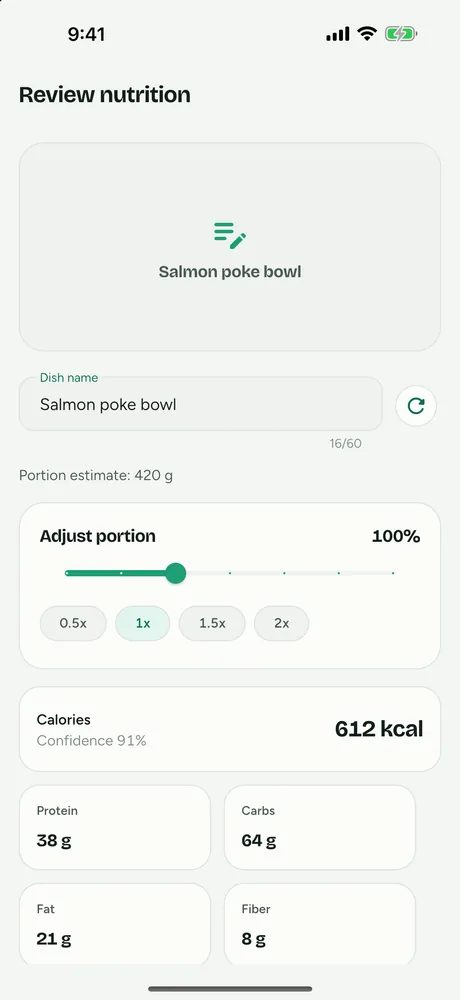
- Read the portion estimate. The review screen shows what the AI assumed, for example "Portion estimate: 420 g".
- Compare it with your hand or object count. If the AI assumed a typical bowl but yours was about one and a half times that, that is your multiplier.
- Set the portion. Drag the slider anywhere from 0.5× to 2× or tap a preset chip. Ate half? Choose 0.5×.
- Edit the numbers if needed. All eight values (calories, protein, carbs, fat, fiber, sugars, sodium, saturated fat) can be edited by tapping them. Use this for the oil or dressing you know was there.
- Use a barcode for packaged food. Barcode results get a grams or ml field, so you can enter the exact amount from the label.
To get a better starting estimate, learn how to take food photos for accurate calorie tracking: whole plate in frame, a fork for scale, sauces visible. Eating out brings its own challenges, from oversized plates to shared dishes; see our tips on estimating restaurant portions.
All of these are estimates for information, not medical advice. If you have specific dietary needs, a registered dietitian can help you set up a method that fits.
Frequently asked questions
How big is a serving of meat compared to my hand?
MedlinePlus (NIH) compares one serving of meat or poultry to the palm of your hand or a deck of cards, and a 3-ounce serving of fish to a checkbook.
What does a cup of food look like?
MedlinePlus compares one cup of chopped raw fruit or vegetables to a woman's fist or a baseball, and half a cup of cooked rice or pasta to a rounded handful or a tennis ball.
Is the hand method accurate?
It is a rough guide. Hands differ in size and foods differ in density, so treat hand portions as estimates. Measuring your usual bowls and spoons once makes your eye much better.
How do I change the portion in FitFoodie?
On the review screen, drag the portion slider anywhere from 0.5× to 2× or tap the 0.5×, 1×, 1.5× or 2× chips. You can also edit any of the eight nutrient values directly before saving.