Yes, ChatGPT and Gemini can estimate calories from a food photo, but expect large errors. In a peer-reviewed 2025 test on 52 weighed meals, GPT-4o missed energy by 35.8% on average and Gemini 1.5 Pro by 64.2%. That's fine for a one-off estimate. For daily tracking, a dedicated app adds what a chat lacks: running totals, goals, history and a barcode database. FitFoodie itself runs on Gemini.
How does a chatbot estimate calories from a photo?
You upload a picture and ask something like "how many calories are in this?" The model identifies the foods it can see, guesses the portion size from visual cues, and applies what it learned about typical nutrition values for those foods. You get back a number, often with a breakdown and some caveats.
That's broadly the same process a photo calorie app uses: recognize, estimate the portion, look up nutrients. The differences are in what happens around the estimate. An app usually asks the model for a fixed, structured answer, shows it to you for correction, and stores it. A chatbot answers in free text, and the format can change from one question to the next.
It also means chatbots share the same blind spots as photo apps. They can't see oil absorbed into food, dressing under the leaves or how deep a bowl is. We explain those limits in why AI misses hidden oils.
How accurate is ChatGPT at counting calories from a photo?
The clearest evidence is a peer-reviewed study by Fridolfsson et al., published in Current Developments in Nutrition in 2025. The researchers photographed 52 standardized meals, weighed the food, and asked three large language models to estimate nutrient content from the images.
| Model tested | Energy error (mean absolute percentage error) | Notable pattern |
|---|---|---|
| GPT-4o (OpenAI) | 35.8% | Underestimated more as portions grew |
| Claude 3.5 Sonnet (Anthropic) | 35.8% | Underestimated more as portions grew |
| Gemini 1.5 Pro (Google) | 64.2% | Significantly overestimated on average (+65 kcal); also fell short on larger portions |
A 35.8% average error means that for a meal that really contains 600 kcal, the estimate would be off by about 215 kcal on average, in either direction. Some estimates will be close and some much further off. And because all three models undershot more as portions grew, big meals are where the numbers are least reliable.
Keep the study's age in mind. It tested GPT-4o, Claude 3.5 Sonnet and Gemini 1.5 Pro. Models change often, and we couldn't find a peer-reviewed, weighed-meal test of the latest versions. Newer models may do better or worse; nobody has published the evidence either way that we could verify.
For context, dedicated apps don't escape the problem either. A preliminary NIH study presented at NUTRITION 2026 found four popular photo apps underestimated meals by roughly 250–345 kcal on average. Our guide on how accurate are photo calorie apps covers that study in detail.
What about Gemini for calorie counting from food photos?
In the Fridolfsson study, Gemini 1.5 Pro had the largest error of the three models, 64.2%, and unlike the others it tended to overestimate. That result is for an older model. We found no peer-reviewed, weighed-meal evaluation of current Gemini models.
We should be upfront here: FitFoodie uses Google Gemini. When you log a meal by photo or text, FitFoodie sends meal photos and text descriptions from our server to Google's Gemini API (currently a Gemini Flash model). Because no independent study has tested that setup, we don't publish an accuracy figure for FitFoodie, and we don't claim it beats asking a chatbot yourself. Treat every result as an estimate to check.
When is a chatbot good enough?
To be fair to ChatGPT and Gemini, they're genuinely useful for some jobs:
- One-off curiosity. You want a ballpark for a dessert or a holiday meal, not a daily log.
- Follow-up questions. A chatbot can explain its reasoning, and you can push back ("there was a lot of butter in that") and get a revised estimate in the same conversation.
- Recipes. Paste a full ingredient list with amounts and ask for a per-serving estimate. With amounts given, the model isn't guessing portions from an image.
- Unusual foods. A general model can talk through a dish that a structured app form doesn't handle well.
If you only log occasionally, a chatbot may be all you need.
What does a chatbot lack compared with a dedicated tracker?
The gap shows up when you try to track every day. A general chatbot isn't built as a food diary, so you end up doing the bookkeeping yourself.
| Need | General chatbot | Dedicated calorie tracker |
|---|---|---|
| Calorie estimate from a photo | Yes, free-form text | Yes, in a fixed set of fields |
| Running daily totals | You add them up yourself | Automatic |
| Goals to compare against | Only if you set and track them yourself | Built in |
| History and trends over weeks | Scattered across chats | Stored per entry, filterable |
| Packaged foods | Estimates from the photo | Barcode lookup against product databases |
| Consistent format | Varies between answers | Same nutrients every time |
| Explaining its reasoning, follow-ups | Strong | Limited |
You can bridge some of this yourself. Keep a note or a spreadsheet, paste in each estimate, and add up the day. That works if you're disciplined about it. The cost is that every step a tracker does automatically, from totals to goals to weekly averages, becomes a manual step you have to remember. Over weeks, those small steps are where logging habits tend to slip, and missing entries make your totals look lower than what you ate.
Barcode lookup is the biggest practical difference for packaged food. A product's label data beats any visual estimate, and a chatbot looking at a wrapper is still guessing.
How do you get better calorie estimates from any AI?
These help with a chatbot and with an app alike:
- Name the hidden fats. Mention cooking oil, butter, dressing and sauces, with amounts if you know them.
- Give amounts. "200 g of cooked rice" beats "a bowl of rice."
- Say how it was cooked. Fried, roasted, grilled and steamed change the fat content.
- Show the whole meal. Include sides and drinks in the photo, or list them.
- Check the result. If the fat looks low for an oily dish, it probably is.
Often, words do more than pixels. If you know what went into a meal, you can describe a meal in text instead of relying on a photo alone.
Where does FitFoodie fit?
We make FitFoodie, so weigh our view accordingly. It uses the same kind of model a chatbot does, wrapped in a tracker:
- Structured results. Each photo or text log returns a dish name, a portion estimate and eight values: calories, protein, carbs, fat, fiber, sugar, sodium and saturated fat. Results are for the dish as a whole, not item by item.
- Review before saving. Scale the portion from 0.5× to 2× and tap any value to change it. Editing the ingredient list doesn't recalculate the numbers, so correct the values directly.
- Goals and totals. Personal calorie and protein targets from your age, sex, height, weight, activity level and goal, using the Mifflin–St Jeor equation, with a daily dashboard.
- Free logging tools. Barcode scanning (Open Food Facts, USDA FoodData Central and FatSecret), water and weight tracking are free.
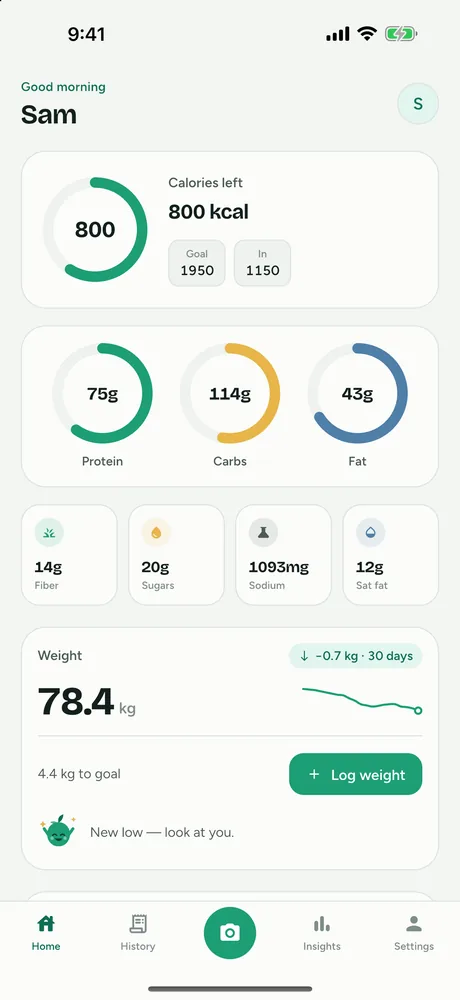
AI photo and text analysis are part of Premium, with a limit of 10 analyses per minute and 150 per day. Photos and descriptions are sent to Google Gemini for analysis. FitFoodie has no web app, no Health app sync and no saved-meal library, so a chatbot is more flexible for open-ended questions.
For how photo logging, barcode scanning and text fit together, read our AI photo calorie tracking guide. Calorie estimates from any AI are for information only, not medical advice.
Frequently asked questions
Is ChatGPT accurate at counting calories from pictures?
Only roughly. In a peer-reviewed 2025 study using 52 weighed meals, GPT-4o's energy estimates were off by 35.8% on average (mean absolute percentage error). Estimates got lower relative to the truth as portions grew. Newer model versions have not been tested the same way in a published study we could find.
Is Gemini better than ChatGPT for calorie counting?
In the one peer-reviewed comparison we found, Gemini 1.5 Pro did worse than GPT-4o, with a 64.2% mean absolute percentage error, and it tended to overestimate. That tested an older Gemini version. We found no peer-reviewed weighed-meal test of current Gemini models.
Does FitFoodie use ChatGPT?
No. FitFoodie sends meal photos and text descriptions from our server to Google's Gemini API (currently a Gemini Flash model). We don't claim it's more accurate than using a chatbot directly. What FitFoodie adds is structure: eight nutrients per meal, an edit step before saving, daily goals, history, and free barcode, water and weight logging.
Can I use ChatGPT and a calorie app together?
Yes. You can ask a chatbot to estimate a homemade recipe, then bring the result into your tracker. In FitFoodie, you can describe the meal in text and adjust the numbers on the review screen to match.